The heroes of the raid on St Nazaire

Raid on St Nazaire
Raid on St Nazaire

A ceremony has been held to remember the heroes of the raid on St Nazaire.

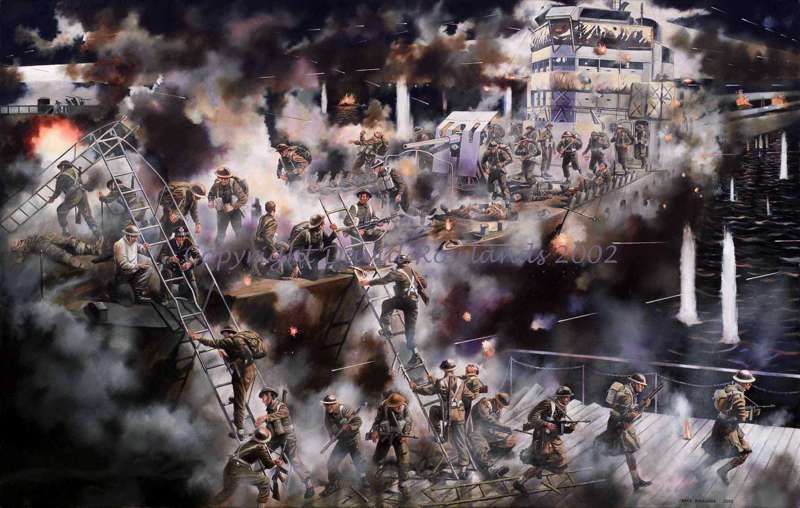
In March 1942, more than 600 men left Falmouth in Cornwall in a flotilla of three destroyers and 16 smaller boats.

The special fleet included HMS Campbeltown, which was packed with explosives and was used to to ram into the gates of the docks in the French port.
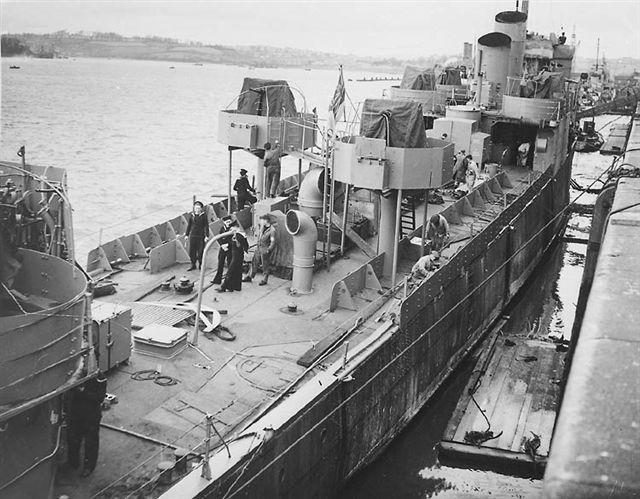
HMS Campbeltown being converted for the raid

St Nazaire was targeted because the loss of its dry dock would force any large German warship in need of repairs, such as the Tirpitz, to return to home waters rather than having a safe haven available on the Atlantic coast.

HMS Campbeltown wedged in the dock gates

The raid put the dry dock out of commission until the end of the war – but success came at a cost. Of the 622 men of the Royal Navy and Commandos who took part in the raid, only 228 men returned to England.

Heroes as prisoners
Heroes as prisoners

One hundred and sixty-nine men were killed and another 215 became prisoners of war. The fallen British raiders were buried at the Escoublac-la-Baule cemetery, near St Nazaire, with military honors.
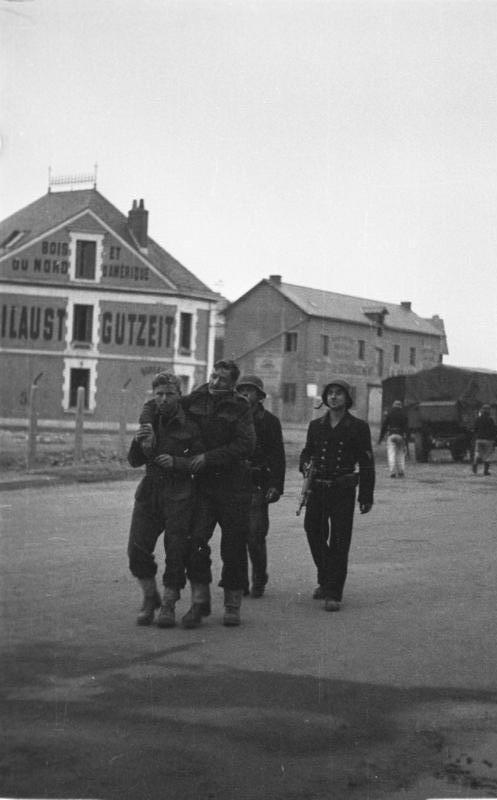
Commandos under prison escort

Five of the raiders escaped overland via Spain.

Eighty-nine awards and medals were bestowed for the raid, including five Victoria Crosses.

The organiser of this weekend’s event in Falmouth, Eric Dawkins, stated:  “The destruction of the dock meant those facilities were no longer able to be used. Falmouth played a major part.

“I’ve known these veterans [who took part], including those few who are still remaining, for 30-odd years and know their tales.”


For St David’s Day: the Welsh National War Memorial

Welsh National War Memorial

The sun shines on the Welsh National War Memorial in Cardiff.

It commemorates the servicemen who died during the First World War. A plaque to those who died during the Second World War was added in 1949.

The memorial takes the form of a circular colonnade surrounding a sunken court and was unveiled in June 1928 by the then Prince of Wales.

It features inscriptions in Welsh and in English, and was designed by Sir Ninian Comper, the Scottish architect who mostly worked on designs for churches.

At the centre of the court is a group of bronze sculptures by Alfred Bertram Pegram, arranged around a stone pylon.

Around the base stand three figures, a soldier, sailor and airman, holding wreaths aloft.

CATHAYS PARK 2

It is situated in Alexandra Gardens, Cathays Park, and is made from the same stone as the civic buildings which surround the gardens.

The Cross of Lorraine smashes a Swastika

November 11 1943 is, I understand, a well-remembered day for historians of the Resistance in Nazi-Occupied France.

It was on that day that the Maquis paraded through the town of Oyonnax in what Matthew Cobb in his excellent book The Resistance describes as a “stunt”.

The event was designed as a show of strength, a morale boost for the local population. The town was chosen because there was no German garrison nearby.

More than 200 Maquisards took part. They marched, sang the Marseillaise and then disappeared back into the mountains.

Sometime ago I came into possession of this small medallion. It features the date ‘XI Novembre, 1943’.

One side is the Cross of Lorraine smashing a Swastika.

medallion. French, dated 'XI Novembre 1943'

On the other side is an Astrix-like warrior.

One side Cross of Lorraine smashing Swastika - previous tweet. Other side this pic of a Astrix-like warrior.I would love to know the story behind it. I assume it relates to Oyonnax, but does it?

When was it created? How many issued?

Please help and share this post if you can.

Thanks.

(I posted this first in 2013. Had some responses. But still trying to get to the bottom of it!)

A little WWII humor

Some great WW2 cuttings. Great collection.

floridaborne's avatarTwo on a Rant

Mymom took a lot of pictures, saved a lot of pictures, and clipped cartoons during WWII (1940’s).   Here are 2 I thought you might enjoy:

cartoon1 001

cartoon2 001

The images were scanned while in the plastic protectors.  Remember, these a cartoons from a 1941 newspaper.  I’m not about to remove a 73 year old newspaper clipping from  43 year old plastic.  

I’ll end this blog post with style, specifically the style worn by my maternal grandfather in 1940:

grandfather 001

View original post

June 1942 (2)

GP's avatarPacific Paratrooper

VP-41 enroute to Kiska to support a fleet bombardment

Alaska

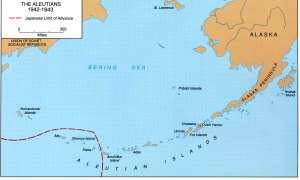
The Japanese Second Mobile Force retired to cruise a support area about 400 miles south of Kiska.  On the second day of attack on Dutch Harbor, two occupation forces moved up to positions from which they could run their objectives.  The first was the Adak-Attu Occupation Force and the second, the Kiska Occupation Force.  As a result of the defeat at Midway [to be dealt with after this preliminary Alaska situation], the Adak occupation was canceled and the Adak-Attu Force was directed to only seize Attu, where a battalion of Army troops went ashore about 0300 hours, 7 June.  The Kiska Force landed a battalion from their Navy at Reynard Cove at 1500 hours, 6 June.

almap1

Due to the weather and the attention given to the attacks on Dutch Harbor, US air reconnaissance did not discover that the occupation of Kiska and Attu was taking place until 4 days…

View original post 658 more words

New Kindle edition of WW2 thriller!

Farewell Leicester Square

A new edition of ‘Farewell Leicester Square’ is out now – with a brand new cover.

One for lovers of Jack Higgins and Alastair Maclean.

In the dying months of the Third Reich a fanatical alliance of SS officers and industrialists plans one final incredible mission to win the war.

They mastermind an ingenious plot to destroy London and force Britain to its knees.

But there is a spy among them.

And while the clock ticks down, a deadly race for survival takes place which could decide the fate of thousands of lives.

The action in this fast-paced novel switches from occupied Jersey to the lives of SOE and Resistance fighters in Belgium.

Intriguingly, it opens in London in 2005, as a terror attack on the city makes sickening headlines around the world.

Buy it now for just £1.29!

Cathedral blitz: “I thought this is what hell must be like”

'Cardiff Blitz' memorial stone
‘Cardiff Blitz’ memorial stone

This memorial stone in the grounds of Llandaff Cathedral, Cardiff, commemorates the damage done to the building during the Cardiff Blitz.

In January 1941 the cathedral was gravely damaged when a landmine blew the roof off the nave, south aisle and chapter house. The top of the spire also had to be partially reconstructed.

In 2011, a church historian told me that many lives were saved by a stroke of luck as the parachute mine snagged on the spire before landing in a dip beside the cathedral.

He said: “This actually absorbed much of the blast although had the bomb fallen directly on the green [where there are homes] or in fact directly on the cathedral then many buildings would have been destroyed and the cathedral obviously obliterated.”

He added: The cathedral organist when he went in the next day said he saw a section of the roof fall, which had fallen like a great arrow, running through the pews and destroying much of the interior.”

One eyewitness, who was seven at the time, was sheltering under the stairs of her family home.

She remembered: “It was such a wonderful night. It was a full moon and it was what they call a hunters moon. That night the hunters were the Luftwaffe.”

Her family was forced from their shelter by a fireman banging on the front door.

“And he shouted get out, he said, the house is on fire, you’ve been hit by a bomb, get out. And I ran out past him into the street screaming. I didn’t go back to my mother and my brother. It was self-preservation!

“They were dropping flares lighting everything up. And also incendiary bombs and we were trying to avoid being hit by any of these things.

“As I was running with all this I was screaming my head off – I thought this is what hell must be like, you know, with all these flames. It was terrifying.”

This photograph shows the cathedral today.

Llandaff Cathedral
Llandaff Cathedral