A truly wonderful book which has thrilled since its first appearance in 1975.
Although the author had been already writing for many years, The Eagle Has Landed established Jack Higgins as one of the great thriller writers of the modern day.
His is a style I absolutely love.
The film starring Michael Caine came out the following year.
The above is the paperback version I first read in the early 1980s.
The novel version of Alistair MacLean’s Where Eagles Dare is not all that it seems.
It’s a classic thriller made into an explosion-filled, action-packed film.
Well, not quite.
In fact, the book started out as the film.
Producer Elliott Kastner approached MacLean directly and asked him for an original script.
MacLean wrote the script and then the book to coincide with the movie’s release.
Years later, Kastner remember the moment he first approached the author.
“I rang Alistair MacLean at his home in Surrey, and told him that I would really like to meet with him. He refused; he didn’t wanna meet without my telling him more details. So I told him: I wanted him to consider writing an original story, directly for the screen. There was a moment of silence, followed by ‘Hmm, nobody ever asked me that before…’
“ ‘So’, he said, ‘What is it you want?’ ‘I want a team of five or six guys on a mission in the Second World War, facing enormous obstacles. I want a mystery. I want a sweaty, exciting adventure movie.’ That’s all I told him, just that.”
And in the book and film that is exactly what we got!
The Bridge on the River Kwai was first published in 1952.
Its writer, French-born Pierre Boulle, had been a prisoner of the Japanese during WW2. He used his experiences as a background to the book.
Interestingly, the original English translation of the French title of the book was The Bridge over the River Kwai. This appears to have been changed after the appearance of the David Lean film.
These are the classic paperbacks many of us grew up with.
I used to scour second hand book shops for them. I’d often end up with two or three versions of the same book.
Kicking off seven days of classic books – all with a WW2 flavour – here is The Dam Busters by Paul Brickhill.
It was originally published in 1951 and was the first of dozens, if not hundreds, of books about the raid on the Ruhr dams.
Brickhill had been a fighter pilot, who had been shot down and imprisoned in Stalag Luft III. His first book, The Great Escape, was about events at that camp.
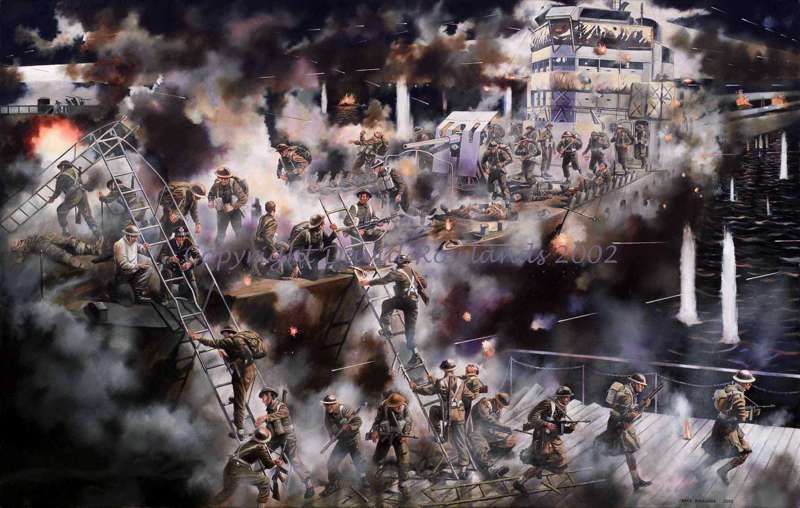
A ceremony has been held to remember the heroes of the raid on St Nazaire.
In March 1942, more than 600 men left Falmouth in Cornwall in a flotilla of three destroyers and 16 smaller boats.
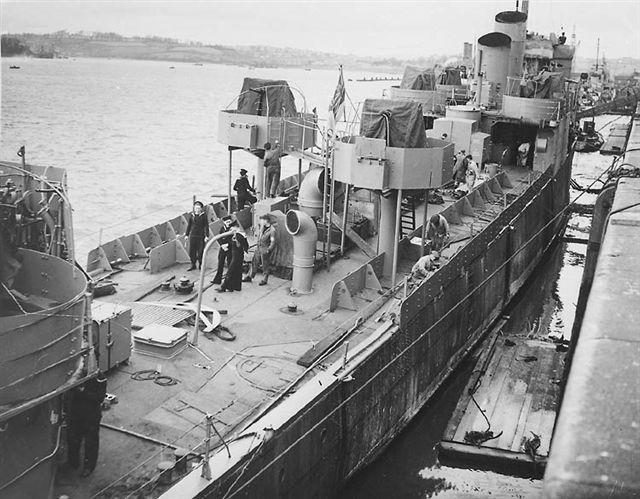
The special fleet included HMS Campbeltown, which was packed with explosives and was used to to ram into the gates of the docks in the French port.
HMS Campbeltown being converted for the raid
St Nazaire was targeted because the loss of its dry dock would force any large German warship in need of repairs, such as the Tirpitz, to return to home waters rather than having a safe haven available on the Atlantic coast.
HMS Campbeltown wedged in the dock gates
The raid put the dry dock out of commission until the end of the war – but success came at a cost. Of the 622 men of the Royal Navy and Commandos who took part in the raid, only 228 men returned to England.
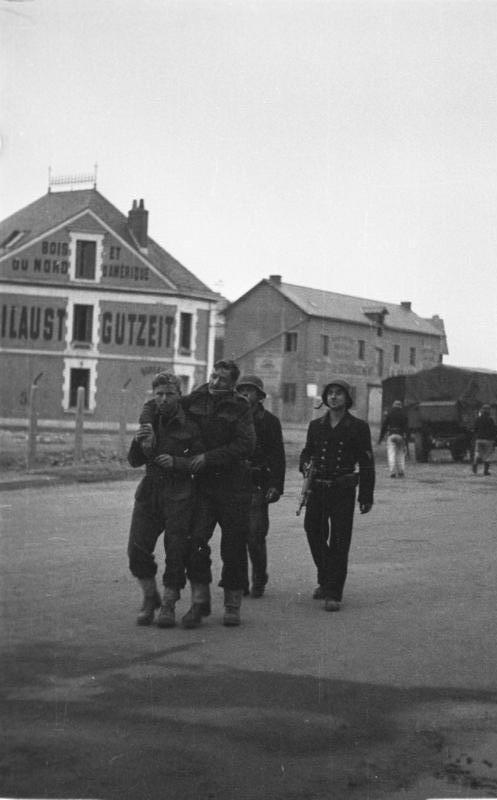
Heroes as prisoners
One hundred and sixty-nine men were killed and another 215 became prisoners of war. The fallen British raiders were buried at the Escoublac-la-Baule cemetery, near St Nazaire, with military honors.
Commandos under prison escort
Five of the raiders escaped overland via Spain.
Eighty-nine awards and medals were bestowed for the raid, including five Victoria Crosses.
The organiser of this weekend’s event in Falmouth, Eric Dawkins, stated: “The destruction of the dock meant those facilities were no longer able to be used. Falmouth played a major part.
“I’ve known these veterans [who took part], including those few who are still remaining, for 30-odd years and know their tales.”
The sun shines on the Welsh National War Memorial in Cardiff.
It commemorates the servicemen who died during the First World War. A plaque to those who died during the Second World War was added in 1949.
The memorial takes the form of a circular colonnade surrounding a sunken court and was unveiled in June 1928 by the then Prince of Wales.
It features inscriptions in Welsh and in English, and was designed by Sir Ninian Comper, the Scottish architect who mostly worked on designs for churches.
At the centre of the court is a group of bronze sculptures by Alfred Bertram Pegram, arranged around a stone pylon.
Around the base stand three figures, a soldier, sailor and airman, holding wreaths aloft.
It is situated in Alexandra Gardens, Cathays Park, and is made from the same stone as the civic buildings which surround the gardens.






 jon kilkade