The village of Breville stands on a hill looking towards Ranville, where the 6th Airborne Division had made its HQ in the days after dropping into Normandy on D-Day.
I took these photographs on June 7 this year. The village remains a place of pilgrimage for many.
The village was taken during fierce fighting on the night June 12, 1944, and into the early hours of the 13th.
These memorials stand in the village today near the church yard, which was the scene of ferocious combat.
Now among the old graves lie some of the 162 British troops who died taking this small village.
Captain HW Ward, of the 53rd (Worcestershire Yeomanry), Airlanding Light Regiment, Royal Artillery.
Private CJB Masters, 12th Battalion (Yorkshire), The Parachute Regiment.
As we approach the 70th anniversary of D-Day, here’s a little feature on a place of great focus to veterans on June 6.
Every year a special service of remembrance is held at Bayeux War Cemetery. It is a very moving event.
These photographs were taken two years ago, on June 6, 2012.
The event was attended by many veterans and their families.
The cemetery contains 4,144 Commonwealth burials of the Second World War, 338 of them unidentified. There are also over 500 war graves of other nationalities, the majority German.
A selection of photographs taken during a recent visit to Pozieres British Cemetery.
Pozieres is a village about six kilometres north-east of Albert, and the cemetery is a south-west of the village on the north side of the main road (D929) from Albert to Pozieres.
According to the Commonwealth War Graves Commission website, the village of Pozieres was attacked on July 23, 1916 by the 1st Australian and 48th (South Midland) Divisions, and was taken on the following day.
It was lost on March 24-25, 1918, during the great German advance, and recaptured by the 17th Division on the following 24 August.
Here are three Australian graves from the cemetery: Privates DB Harford, FB Dowling and L Robinson.
Three Australian graves at Pozieres.
There are 2,760 Commonwealth servicemen buried or commemorated in this cemetery -1,382 of the burials are unidentified but there are special memorials to 23 casualties known or believed to be buried among them. There is also one German soldier buried here.
Lines of graves at Pozieres.
This grave contains the remains of Military Medal winner, Private D Cottingham.
German soldier Georg Fuchs lies with two comrades in the corner of the British cemetery opposite the Ploegsteert Memorial in Belgium.
Georg Fuchs
The Hyde Park Corner cemetery is at the scene of a road junction to the north of Ploegsteert Wood (‘Plug Street’ to the British soldiers).
The cemetery was begun in April 1915 by the 1st/4th Royal Berkshire Regiment and was used at intervals until November 1917. It contains 83 Commonwealth burials of the First World War.
The German war graves are at the rear.
Three German graves.
Two of the German soldiers are unidentified.
Unidentified graves.
Nearby there is a Jewish soldier of the Loyal North Lancs Regt.
A brief story of two Royal Welch Fusiliers who were wounded at battles for woods on the Somme.
Their graves are located in the cemetery at Abbeville, which was some way from the front.
Abbeville cemetery
I took these photos some years ago and now the wonderful Anne Pedley, of the Royal Welch Fusiliers Museum in Caernarfon, has helped me piece together parts of the stories of Ceredig Ellis and Edward Roberts.
Ceredig Ellis
Second Lieutenant Ellis, whose parents were from Aberystwyth, was married to Mildred and lived 61 Oxton Road, Wallasey, Cheshire.
He was educated at Bangor University where he was a member of the OTC.
He was commissioned on February 1, 1915. He was transferred to 15th RWF (the London Welsh) and joined the battalion in France.
He saw action with D Company and was wounded at Mametz Wood on July 11, 1916.
He was to die of these wounds, most likely at Abbeville where there was a large military hospital.
Ceredig’s grave – detail
As the inscription on the grave indicates Mildred had recently given birth to their first child.
The second fusilier, CSM Roberts, enlisted with 10th RWF and embarked to France on September 27, 1915.
He received the Military Medal for bravery while in trenches in the Kemmel area, where the Fusiliers defended themselves against a German gas and an infantry attack.
Edward Roberts
He also fought at High Wood and it was during fighting there that he was first reported missing and then wounded.
He died of his wounds at Abbeville ten days later.
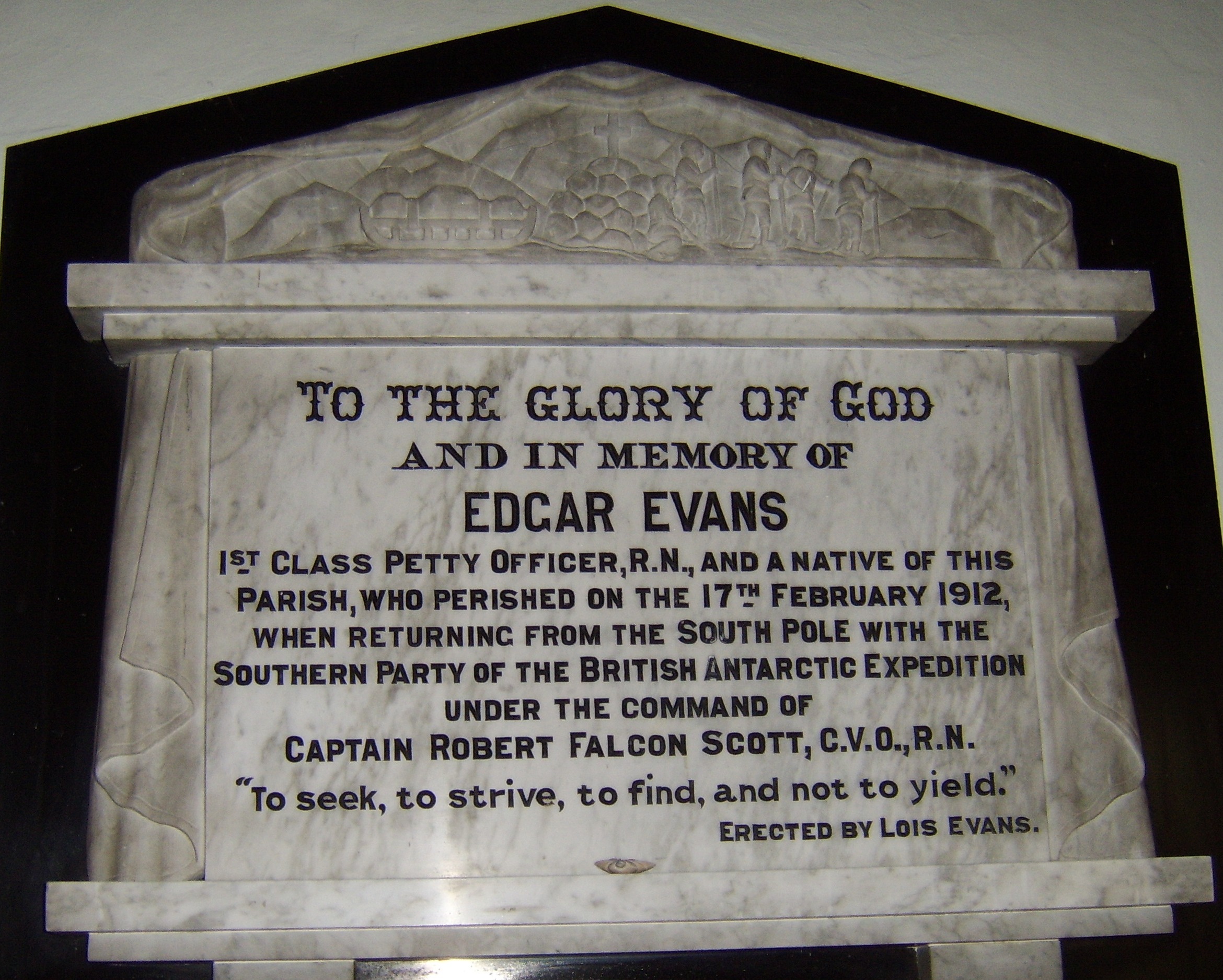
He is one of Wales’ greatest explorers – but few remember his name and there is no national monument in his honour.
There is a story behind why Wales may have tried to forget Edgar Evans – and it concerns a sense of misplaced shame.
Evans was with Captain Robert Scott when he stood at the South Pole more than 100 years ago. Upon arriving at the Pole they were already exhausted.
Their spirits sunk further when they realised Roald Amundsen had got there first.
Scott’s party was defeated first by the Norwegians and then by a terrible Antarctic winter which came in early and closed over them like a shroud.
Evans was the first of the five men to die. He was malnourished and a cut in his hand was festering.
On February 17, 1912, his exhausted body gave up.
The second to die, Captain Oates, had a leg wound which had turned gangrenous. His leg needed amputating. He crawled from the expedition tent in a blizzard around March 17th and was not seen again.
The remaining three – Scott, himself, Bowers and Wilson – died about 10 days later.
It took a year for the news of their deaths to reach Britain.
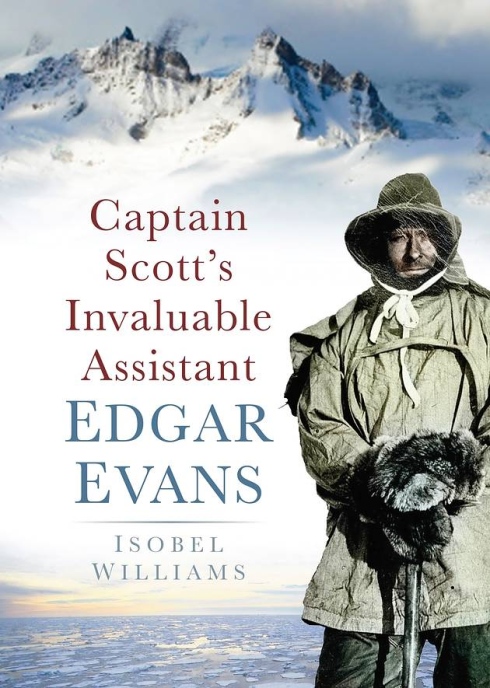
“People were initially very sad, then proud but then they had to try and find an explanation,” Dr Isobel Williams, author of a biography on Edgar, called ‘Captain Scott’s Invaluable Assistant’, says.
“In some newspapers they focused on Edgar as not only failing and slowing them down but by his failure and slowing the party he caused the death of all the expedition.”
The men had left Britain in 1910, sailing from Cardiff on board the Terra Nova with South Wales’ coal lighting its boiler.
Two nights before they left, the crew had celebrated at the Royal Hotel in St Mary Street. A century later the Captain Scott Society still meets there. Wales had contributed about half of the funds needed for Scott’s expedition.
But when news reached Britain of the men’s deaths, some began to feel a little ashamed of Evans.
Edgar’s grandson, John Evans, from Swansea, said on the 100th anniversary of the explorer’s death: “I think it was based on snobbery a bit because they made him the scapegoat in the beginning.”
Evans had been on not only the mission to the South Pole but Scott’s 1901-1904 Discovery expedition which had helped prove Antarctica was a continent and not a massive pack of ice.


 The village of Breville stands on a hill looking towards Ranville, where the 6th Airborne Division had made its HQ in the days after dropping into Normandy on D-Day.


 Private CJB Masters, 12th Battalion (Yorkshire), The Parachute Regiment.


 jon kilkade