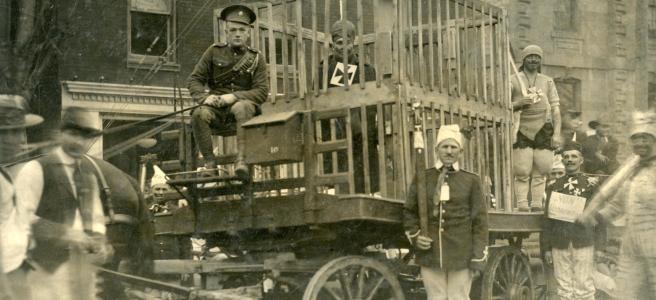
I was unaware of the story behind this unusual postcard when I purchased it at an antiques fair last fall however my research has uncovered an interesting tale. The photo shows a young driver from the Canadian Army Services Corps pulling a wagon with “Old Kaiser Bill” locked up in a wooden cage. The card is not dated but includes a hand-written message on back which reads:
“These are the polash (sic) soldiers that acted up these pictures. See Old Kaiser Bill in the cage and the Prince with his white pants and bound in rope.”
The Prince, presumably Kaiser Wilhelm’s oldest son Friedrich Wilhelm Victor August Ernst, is wearing what appears to be a 19th Century Canadian Militia 7-button tunic with “Austrian Knot” cuffs. The wagon is surrounded by a handful of other characters including one wearing a home-made pickelhaube and holding a sign that says “Von Luddendorff”.
This memorial stone in the grounds of Llandaff Cathedral, Cardiff, commemorates the damage done to the building during the Cardiff Blitz.
In January 1941 the cathedral was gravely damaged when a landmine blew the roof off the nave, south aisle and chapter house. The top of the spire also had to be partially reconstructed.
In 2011, a church historian told me that many lives were saved by a stroke of luck as the parachute mine snagged on the spire before landing in a dip beside the cathedral.
He said: “This actually absorbed much of the blast although had the bomb fallen directly on the green [where there are homes] or in fact directly on the cathedral then many buildings would have been destroyed and the cathedral obviously obliterated.”
He added: “The cathedral organist when he went in the next day said he saw a section of the roof fall, which had fallen like a great arrow, running through the pews and destroying much of the interior.”
One eyewitness, who was seven at the time, was sheltering under the stairs of her family home.
She remembered: “It was such a wonderful night. It was a full moon and it was what they call a hunters moon. That night the hunters were the Luftwaffe.”
Her family was forced from their shelter by a fireman banging on the front door.
“And he shouted get out, he said, the house is on fire, you’ve been hit by a bomb, get out. And I ran out past him into the street screaming. I didn’t go back to my mother and my brother. It was self-preservation!
“They were dropping flares lighting everything up. And also incendiary bombs and we were trying to avoid being hit by any of these things.
“As I was running with all this I was screaming my head off – I thought this is what hell must be like, you know, with all these flames. It was terrifying.”
George William Burdett Clare took part in actions in France which would win him the Victoria Cross.
Clare, who was born in St Ives, Cambridgeshire, on May 18, 1889, was a 28-year-old private in the 5th Lancers (Royal Irish).
He was awarded the Victoria Cross for his actions on November 28/29, 1917 at Bourlon Wood, France, during the Battle of Cambrai, at which he was killed.
This photograph, taken earlier this year, shows his name on the Cambrai Memorial to the Missing at Louverval.
The citation for his VC, which was published in the London Gazette on January 8, 1918, reads:
“For most conspicuous bravery and devotion to duty when, acting as a stretcher-bearer during a most intense and continuous enemy bombardment, Pte. Clare dressed and conducted wounded over the open to the dressing-station about 500 yards away. At one period when all the garrison of a detached post, which was lying out in the open about 150 yards to the left of the line occupied, had become casualties, he crossed the intervening space, which was continually swept by heavy rifle and machine-gun fire, and having dressed all the cases, manned the post single-handed till a relief could be sent. Pte. Clare then carried a seriously wounded man through intense fire to cover, and later succeeded in getting him to the dressing station. At the dressing-station he was told that the enemy was using gas shells to a large extent in the valley below, and as the wind was blowing the gas towards the line of trenches and shell-holes occupied, he started on the right of the line and personally warned every company post of the danger, the whole time under shell and rifle fire. This very gallant soldier was subsequently killed by a shell.”
Wales-born Richard William Leslie Wain was awarded the Victoria Cross after his actions on November 20, 1917, during the Battle of Cambrai.
Born in Penarth, near Cardiff, Wain had fought on the first day of the Battle of the Somme with the 17th Battalion of the Manchester Regiment.
He had been wounded during the fighting for the village of Montauban.
He later joined the Heavy Section of the Machine Gun Corps which was equipped with tanks and took part in the Battle of Messines in June 1917.
In November 1917, aged 20, he was a section commander and acting captain in A Battalion, Tank Corps, when he took part in fighting at Marcoing, near Cambrai.
The citation for his Victoria Cross reads:
“For most conspicuous bravery in command of a section of Tanks. During an attack the Tank in which he was, was disabled by a direct hit near an enemy strong point which was holding up the attack. Capt. Wain and one man, both seriously wounded, were the only survivors. Though bleeding profusely from his wounds, he refused the attention of stretcher-bearers, rushed from behind the Tank with a Lewis gun, and captured the strong point, taking about half the garrison prisoners. Although his wounds were very serious he picked up a rifle and continued to fire at the retiring enemy until he received a fatal wound in the head. It was due to the valour displayed by Capt. Wain that the infantry were able to advance.”
This photograph, taken earlier this year, shows his name on the Cambrai Memorial to the Missing.
Frederick Henry Johnson led several charges on positions on Hill 70 on September 25, 1915, for which he was later awarded the Victoria Cross.
A second lieutenant in the 73rd Field Coy., Corps of Royal Engineers, Johnson was 25 years old at the time of the attack which was part of the Battle of Loos.
The citation for his VC was published in in the London Gazette on November 16, 1915. It reads:
“For most conspicuous bravery and devotion to duty in the attack on Hill 70 on 25 September 1915. Second Lieutenant Johnson was with a section of his company of the Royal Engineers. Although wounded in the leg, he stuck to his duty throughout the attack, led several charges on the German redoubt, and at a very critical time, under very heavy fire, repeatedly rallied the men who were near him. By his splendid example and cool courage he was mainly instrumental in saving the situation and in establishing firmly his part of the position which had been taken. He remained at his post until relieved in the evening.”
Johnson later achieved the rank of major but was killed in action in Bourlon Wood, France, on November 26, 1917.
This photograph, taken earlier this year, shows his name on the Cambrai Memorial to the Missing.




 jon kilkade